Our History
Militia Years (1855-1884)
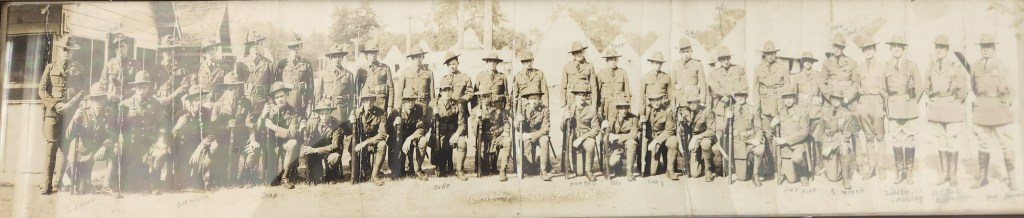
The 161st Infantry can trace its roots to the early militia companies formed in 1855 and 1856 throughout the Puget Sound area and eastern Washington. These companies were formed by ordinary men who wanted to protect families and property from the growing discourse between local Native Americans and the settlers who were moving in.
Most early militiamen had no formal military experience, yet they set an early standard for the current Washington National Guard to follow
The World War (1917-1919)
The 2nd Regiment, Washington National Guard was mobilized in April 1917 anticipating service in France. Rather than fighting the Hun, Guardsmen spent the next several months guarding war industry and infrastructure around Washington State. As fall arrived, the War Department instituted a numbered Regiment plan and the 2nd Regiment became the 161st Infantry Regiment. While the rest of the 41st Division headed to South Carolina for training, the 161st found itself in New York preparing to go “over there” in the war to end all wars. The 161st landed in France in December 1917 and was relegated to support duties. By mid-1918, many of the NCOs had left for Officer Candidate School and large numbers of enlisted soldiers were transferred to front-line units as replacements. By October 1918, the Regiment was nearly at full strength filled with draftees and preparing for the final push into Germany. With the end of hostilities on November 11, 1918, the Regiment was mostly reunited and prepared to return home. The Regiment landed in New York and New Jersey in February and March 1919 and was released from active duty.
World War II (1940-1945)
After a 42-year absence, the 161st Infantry found its destiny in the South Pacific once again.
The 161st Infantry continued to serve as a component of the 41st Division when the division was called into 1 year of Federal Service on Sept 18, 1940, by Executive Order signed by President Franklin Roosevelt. The mobilization station was Camp Murray … or Swamp Murray as it became known during the fall and early winter of 1940. The environment was so miserable that illness affected the men like an epidemic and news articles about the poor conditions were published nationally.
In October 1941, the 41st Division was reconfigured from a square division (four infantry regiments) to a triangular division (three infantry regiments) and the 161st Infantry was considered surplus. However, the War Department had more important plans for the Regiment. After filling its ranks from other Regiments of the 41st Division, the 161st left Fort Lewis on 6 Dec 1941 by train towards San Francisco. War Department orders were to board transports and steam back to the Philippine Islands. Before leaving Fort Lewis, 35 members of the Regiment of Japanese and Chinese ancestry were transferred to other units.
The 161st landed on Guadalcanal in January 1943 as a member of the 25th Division. Their mission was to provide fresh troops to the stalemate fight with Japanese troops on Guadalcanal. During the next several months, they helped defeat the Japanese and learned many of their tricks that would be helpful on the next stop.
New Georgia was supposed to be an easy fight. However, the two US divisions assigned to take the island struggled almost immediately and needed help. Despite the 161st Infantry operating at only 60% strength, the Regiment was committed to New Georgia at the end of July 1943. Due to the fog of war, it took the 161st a full week to fight its way to the Line of Departure losing more casualties to enemy action and the harsh jungle environment
The Regiment’s deeds were the subject of two Yank magazine articles:
“Infantry Battle on New Georgie”, Yank Oct 1943
“Attack On Hastings Ridge”, Yank, Nov 1943
As the Regiment started filling its ranks and training for the invasion of Japan, the war quickly came to an end thanks to the dropping of nuclear bombs on Hiroshima and Nagasaki. The Regiment left the Philippines destined to serve in Japan as an occupation force. The Regiment landed in Japan on 25 Oct 1945 moving into Nagoya. However, the War Department decided it was time for the Regimental Colors to end its Federal Service. On 1 Nov 1945, the 161st Infantry Regimental colors were cased and the 4th Infantry Regimental colors were uncased. The people didn’t change, only the flag they gathered under. The Regimental colors were returned to the United States accompanied by the final 4 members still with the Regiment since mobilization in Sept 1940.
National Guard Restructured (1947-2000)
The US Congress called for the restoration of the National Guard in 1947 partially due to the looming Soviet threat. During the Cold War, the Regiment was reorganised several different times and continued to fulfil its state mission by supporting residents affected by natural disasters and civil unrest. Its strategic mission to defend the Pacific kept it out of other conflicts.
Global War on Terrorism (2000-Current)
As with the rest of the US, everything changed on Sept 11, 2001. While waiting for a federal mobilization, members of the 161st Infantry participated in numerous security missions across Washington State as part of Operation Noble Eagle. The Global War on Terrorism did not mean an end to state missions, in fact, the 161st has been called on several times to provide assistance to residents affected by natural disasters as well.
OIF II (2004-2005)
The 161st mobilized in November 2003 for duty in the Middle East. By April 2003, the 161st Infantry was performing a variety of operations in the Baghdad area before returning home in April 2004.
OIF (2008-2009)
In early 2008, the 161st was again mobilized for service in Iraq. This time the Regiment was tasked with providing convoy security for convoys moving from one corner of Iraq to the other.
“Add a testimonial from someone who loves what you do.”
Jane Doe
 The 1st BN 161st Infantry Highlander Association